 The economic downturn of the 1970s brought new challenges for the designers of high-end lamps and other luxury goods, as producers’ support for the experiments of the 1960s gave way to a constant refrain of “No thanks”, “It’s too expensive”, or “It can’t be sold”.
Among Louis Weisdorf’s 1970s lamp designs, the Multi-Lite is one of the few to be taken into production – and if it hadn’t been for the climate of austerity and the consequent policy of restraint, it would be known today not just as a pendant light but also as a floor lamp and a wall light.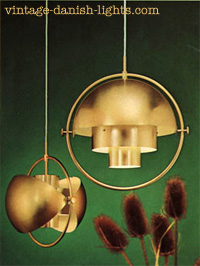
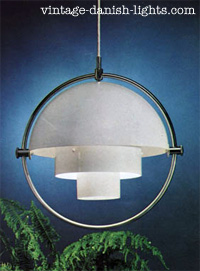
The core of the Multi-Lite is a two-cylinder form that would work as a shade on its own but is additionally encompassed by a large metal ring anchoring two quarter-spherical shells. The shells can be individually rotated to create multiple arrangement combinations. In Weisdorf’s Copenhagen studio a large poster illustrates several of the numerous possible arrangements.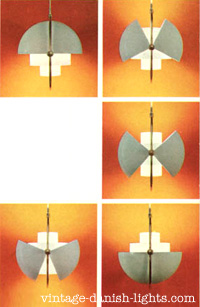
Weisdorf made the drawings for the Multi-Lite in 1972 and Lyfa produced it from 1974. It came out in two colourways – one in white with a chrome ring, and the other in matt-finished brass with a white interior.
The Multi-Lite is an exception to the Weisdorf rule of multiply repeating elements, but reflects another of his passions – for objects that can do something, change into something else, be “multi”. 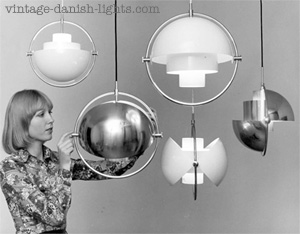 It can be an uplighter one day, a downlighter the next, an asymmetrical art light the third. “It’s a bit more complex,” says Weisdorf about this light.
The Multi-Lite’s timeless expression meant it fitted well into domestic settings in each of the following decades, so that it has been in use in many homes to this day and has consistently tended to fetch high prices at auction and elsewhere.
© 2011 Sune Riishede and vintage-danish-lights.com. All rights reserved. This article is based on extensive correspondence between Louis Weisdorf and Sune Riishede and a personal meeting in November 2011 at the architect’s Copenhagen residence. The article and its contents may not be copied or reproduced in any part or form without the prior written permission of the copyright holders. Links to http://www.vintage-danish-lights.com/the-lights-of-louis-weisdorf-multi-lite-1974 are welcome.
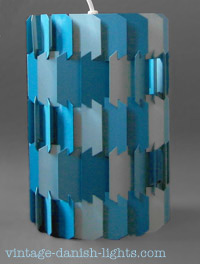
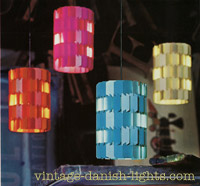
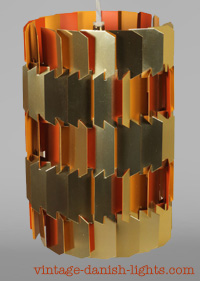
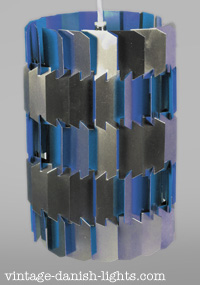
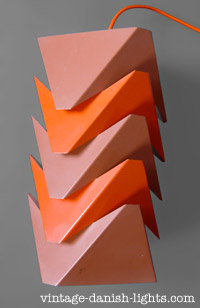 The Ekko is another of Louis Weisdorf’s designs based on repeating – or echoing – elements, though in this case the angular metallic sections take two forms, the two end pieces differing from the three central ones.
 – while still at Tivoli – set up his own design studio in Kompagnistræde in Copenhagen’s old city, sharing the premises with architect Ole Panton (the younger brother of Verner), who also designed lamps. The Ekko had a diameter of 19cm and a height of 32cm, and came in two colour schemes – orange/terracotta and lilac/violet.
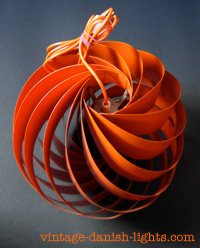 Louis Weisdorf created the design for his Turbo pendant light in 1965, and in 1967
 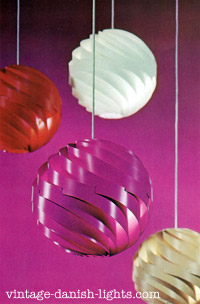 to Weisdorf’s guiding principle of shielding the eye from direct bulb glare at all angles. Like other experimental lights of that decade, it was expensive – the larger version, Turbo II, coming with a price tag not much below an average worker’s monthly wage.
 Much later – in 1991 – a new version of the Turbo was put into production by the further-merged company Lyskjær-Lyfa, without the knowledge or approval of Louis Weisdorf. Renamed Regina and made of steel, the lamp was so heavy it had to be suspended by a wire. Weisdorf took the company to court and sales were halted.
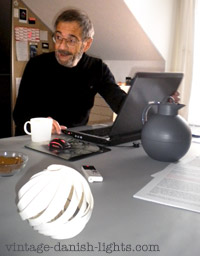 interest in Weisdorf’s lighting designs, and rekindled his passion for lamp design after 25 years during which he became one of the first Danish architects to move into the digital era and start using computer-aided design (CAD). The rediscovered lighting enthusiasm led to models of new lamp designs beginning to appear on his computer screens.
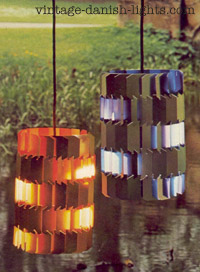 In the Facet pendant light, designed by Louis Weisdorf in 1963 and produced by
 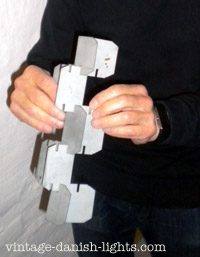 How did Weisdorf think up the Facet? “I have always been interested in creating lights from a single element that could be repeated and built together in various fashions, fitting into each other, turned, stacked, hung in various ways and so on,” he says. “Since my youth I seemed to have an ability to visualise things in space, to see how forms function together in space. This was probably why I was accepted into architecture school in the first place.”
 During the war the 11-year-old Weisdorf had to stay in Sweden for some years, and missed so much schooling that he was prevented from going on to high school. That didn’t stop him from finding a back door to academic studies by taking a preliminary year at engineering school (intended for craftsmen), then applying for admittance to the Royal Academy at the unusually early age of 17. Against all odds he was accepted on to the course, and during the three-month trial period the teachers spotted someone with a special gift in spatial geometry.
 This talent was of course used on the
 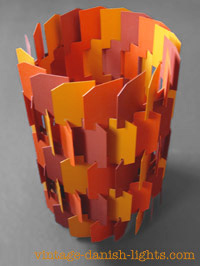 and, like the Konkylie, its production was contracted out by Lyfa to the Brødrene Berg factory. Its colour schemes harmonised with the Konkylie – one version golden outside with two shades of orange inside, the other silver outside and two shades of blue inside.