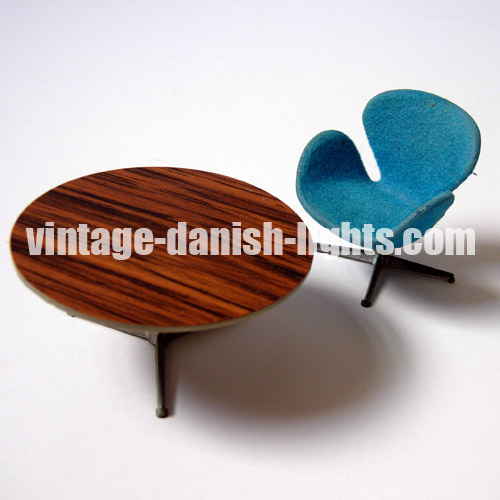
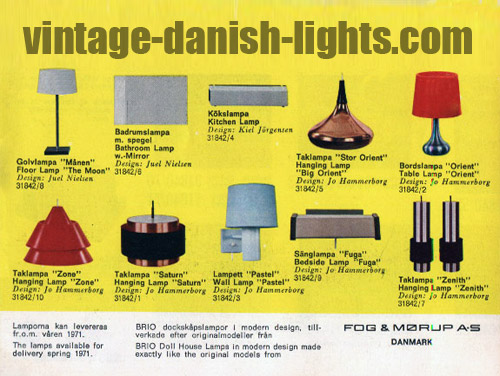
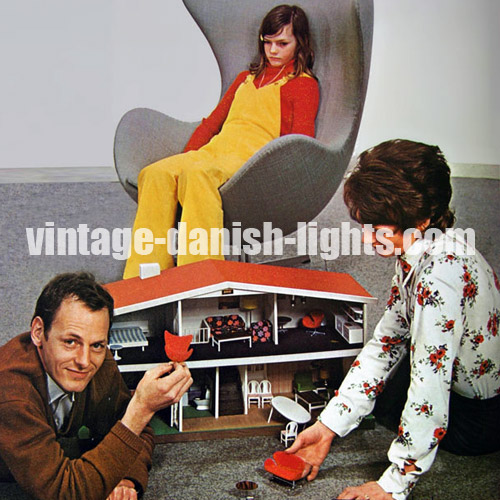
In the early 1970s Swedish toy manufacturer Brio Scanditoy Mobilia produced miniature versions of some of the interior design classics of the day for use in furnishing their internationally popular dolls houses. Furniture by Arne Jacobsen featured prominently amongst these miniatures (see examples pictured below), but for lighting Brio turned to designs from Fog & Mørup, offering tiny versions of Jo Hammerborg’s Orient, Zone, Saturn and Zenith pendant lamps and his Orient table lamp and Pastel and Fuga wall lamps, along with Juel Nielsen’s Moon floor lamp and mirrored bathroom light and Kiel Jörgensen’s kitchen light.
Month: December 2010
-

Fog & Mørup lights in Brio miniatures
-

More on Utzon and the Søværnspendel
Following our recent piece on the debate about whether Jørn Utzon or the Danish Navy designed the Søværnspendel (which can be read here), we received an interesting email from Hans Marvell of &tradition, the current producer of the Utzon Pendel, the light now known as the Tivoli and pictured here with Utzon at his own home in an image reproduced from a 1955 issue of Møbler magazine.
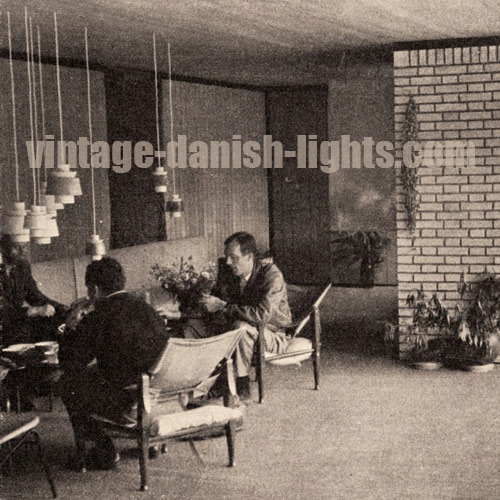
With regard to the Søværnspendel debate, Marvell tells us that the Nordisk Solar Compagni production was the original, with the (now better known) Louis Poulsen version following later. He also confirms that Jørn Utzon was not the light’s designer, but makes the intriguing suggestion that Jørn Utzon’s father Aage may have had a hand in its creation. He writes:
As far as we can work out, there is a good chance that either Jørn Utzon’s father or one of the other members of the navy’s technical office drew the Søværnspendel. Jørn Utzon’s father was a naval architect and his drawings and sketches are said to have laid the foundations of Utzon’s interest in architecture and design. The Søværnspendel predates the Tivoli pendant we make, and has been passed from one manufacturer to another. Initially produced by Nordisk Solar, the production was sold to Louis Poulsen, who took over all of Nordisk Solar’s consumer lamps. Today Nordisk Solar focuses on industrial lighting. Louis Poulsen made the Søværnspendel right up until the mid 1980s and it is found hanging in many public offices and schools in Denmark. A key thing to consider is that in the 1950s product names were still very uncommon. This is why both our Tivoli lamp and the Søværnspendel are difficult to research. However, I can confirm that according to the Utzon family’s knowledge, the Tivoli lamp from 1947 is the first acknowledged lamp designed by Jørn Utzon.
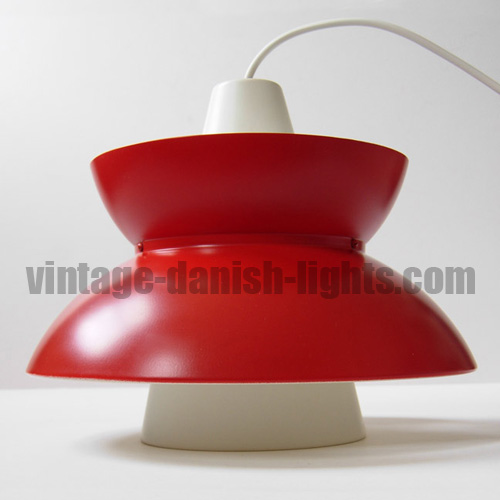
Below: the Louis Poulsen version of the Søværnspendel
-

Hvidt & Mølgaard’s F&M light design
Peter Hvidt (1916–1986) and his business partner Orla Mølgaard (aka Orla Mølgaard-Nielsen) (1907–1993) are best known for their furniture – in particular the Ax chair, designed in 1950 for Fritz Hansen, and the 1956 Boomerang chair for France & Son – but they also created lamps for Le Klint and Nordisk Solar Compagni.
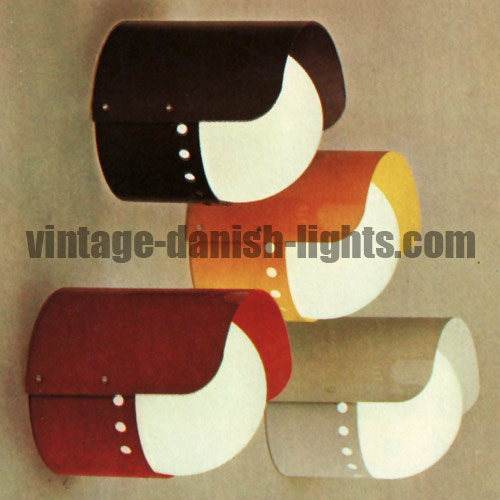
Less well known is the fact that they designed a light in the mid to late 1970s for Fog & Mørup. Entitled Dome and described by F&M at the time as “untraditional”, the lamp featured a translucent plastic globe with an aluminium shade in brown, red, yellow or white, and was intended for use in locations such as bathrooms and hallways.
-

Jørn Utzon and the Søværnspendel
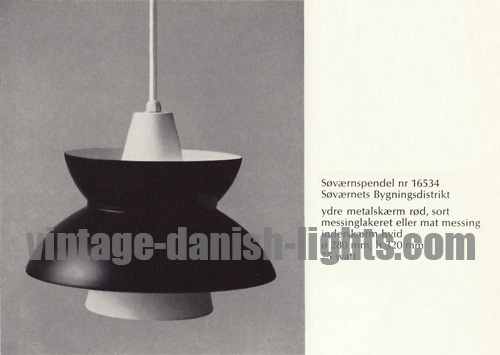
The question of who designed the light known as the Søværnspendel has been the subject of much debate in recent years, with opinion divided between those who believe it to be a Jørn Utzon creation and those who say it was designed by the Danish Navy. The issue is complicated by the fact that there are three versions of the light – one produced by Louis Poulsen (first image below) and the other two by Nordisk Solar Compagni (second and third images below).
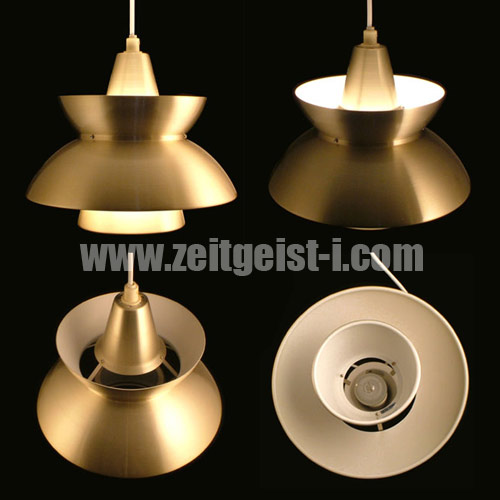
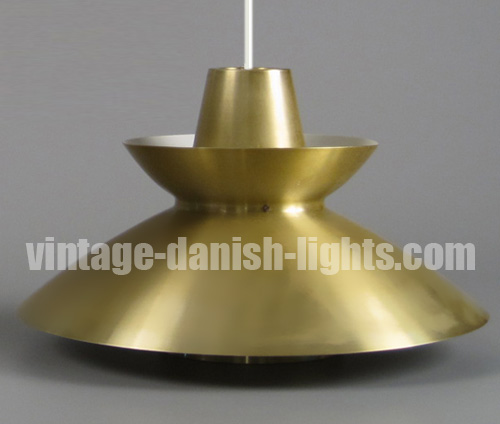
The Louis Poulsen production gives the light its Søværnspendel name by which both Poulsen and Nordisk Solar Compagni versions are generally known. Søværnspendel means Navy Pendant, and the designer of the Louis Poulsen Søværnspendel is listed in a 1967 catalogue as the Søværnets Bygningsdistrikt (Navy Buildings Department).
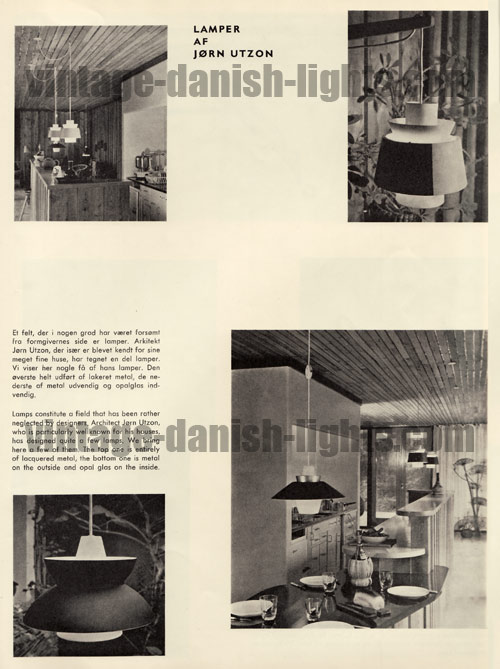
It is the Nordisk Solar version to which Jørn Utzon’s name has often been attached, and the source for this attribution is usually given as a 1956 edition of Mobilia. Sure enough, the light appears in the July 1956 issue of that magazine, accompanied by the following text:
Lamps constitute a field that has been rather neglected by designers. Architect Jørn Utzon, who is particularly well known for his houses, has designed quite a few lamps. We bring here a few of them. The top one is entirely of lacquered metal, the bottom one is metal on the outside and opal glass inside.
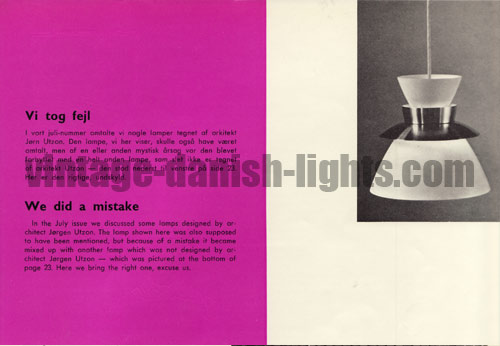
However, this attribution is thrown into confusion by the August issue of the magazine, in an erratum entitled “We did a mistake”, which reads:
In the July issue we discussed some lamps designed by architect Jørgen Utzon. The lamp shown here was also supposed to have been mentioned, but because of a mistake it became mixed up with another lamp which was not designed by architect Jørgen Utzon – which was pictured at the bottom of page 23. Here we bring the right one, excuse us.
Unfortunately it is less than entirely clear which of the two lights pictured at the bottom of the page in the July issue is being referred to in the erratum as “not designed by architect Jørgen Utzon”. We are left to draw our own conclusions. On the one hand, the July page referred to the “bottom” light as being metal and opal glass, which would indicate the lamp pictured to the bottom right. But while we at vintage-danish-lights.com are not familiar with that specific light design (see close-up view below), it looks as if it might be a member of the Terrazze family, illustrated in the 1958–1959 edition of The Studio Year Book of Furnishing & Decoration and reproduced in Taschen’s Decorative Arts 1950s (final image below).

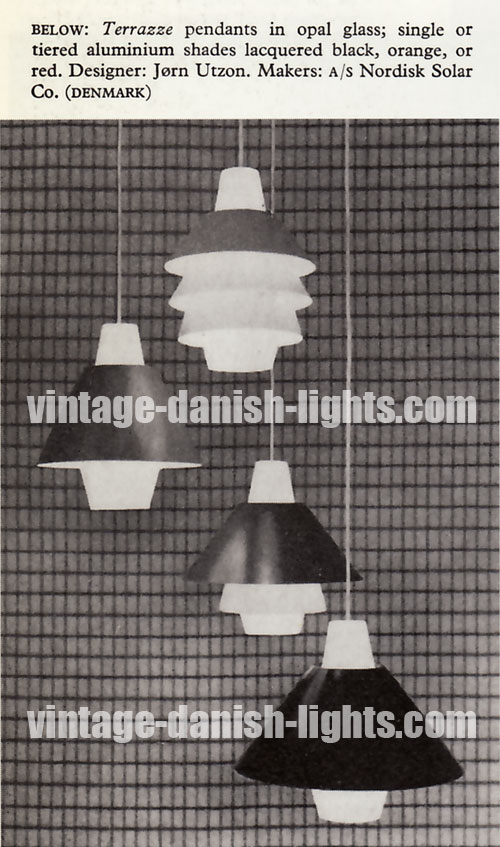
On balance, we tend towards concluding that it probably is the Søværnspendel that is being denied as an Utzon design. But if this is the correct conclusion, the question remains: who did design the Nordisk Solar Compagni light? Ulf Hard af Segerstad’s 1961 book Scandinavian Design tells us that Nordisk Solar Compagni’s lighting in the 1950s was designed by architects Max Bruel, Sven Middelboe and Jørn Utzon, and if Utzon is indeed ruled out, our money is on Sven Middelboe. If anyone can clear up this enduring mystery, we’d love to hear from them. Please leave a comment or email us at info@vintage-danish-lights.com.
UPDATE: A Danish-speaking reader has kindly brought to our attention some subtleties in the Danish version of the Mobilia texts that have been omitted from the English translations printed in the magazine, and which confirm that the Søværnspendel is the lamp being referred to as not designed by Utzon. Our reader writes:
Firstly, the Danish text on the first page says, “Den øverste helt udført af lakeret metal, de NEDERSTE af metal udvendig og opal glas indvendig”, which should be translated as, “The top one is entirely of lacquered metal, the BOTTOM ONES [ie, plural not singular] are metal on the outside and opal glass on the inside.” This means that the lamps that were planned to be illustrated were both made of metal and glass (like the lamp on the right), which the Søværnspendel is not, of course.
Secondly the Danish text in the erratum states that the lamp which was not designed by architect Jørn Utzon “stod nederst til VENSTRE påe side”, which should correctly be translated as “was shown AT BOTTOM LEFT of the page”. This clearly means that it is the lamp to the left that is not designed by Utzon (ie the Søværnspendel). -

The birth and afterlife of F&M’s Semi
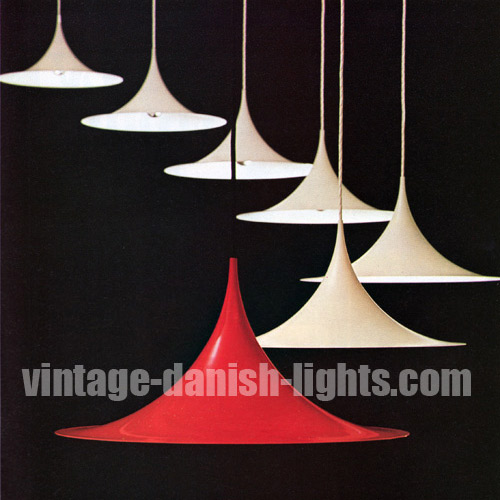
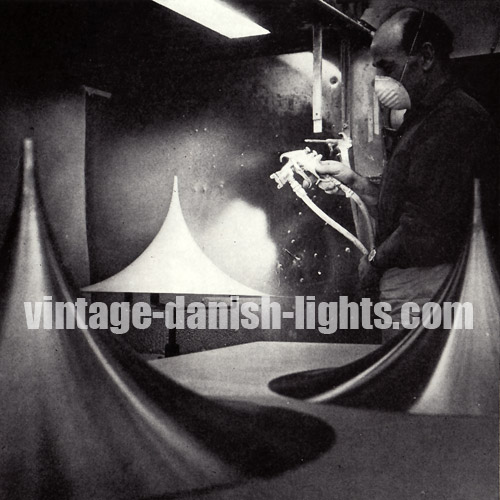
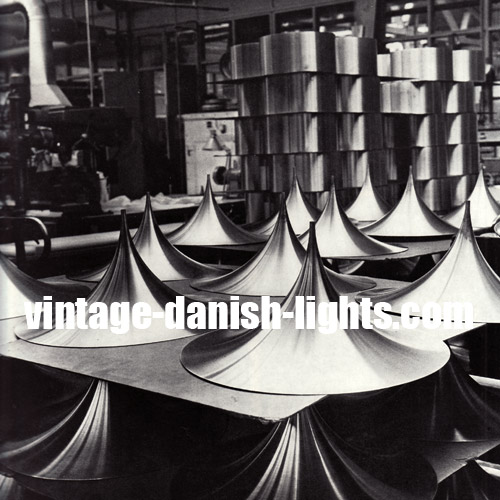
Designed in 1967 by Claus Bonderup and Torsten Thorup when they were still students and put into production by Fog & Mørup, the Semi was an immensely popular light. An article in a 1973 edition of Mobilia magazine described the process by which each Semi was hand-produced at Fog & Mørup’s busy office-factory complex at Søborg on the outskirts of Copenhagen.
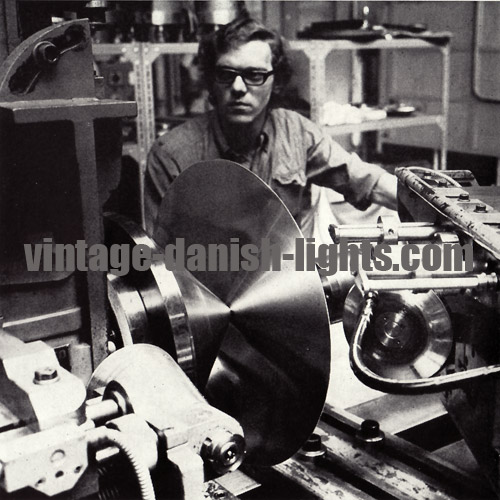
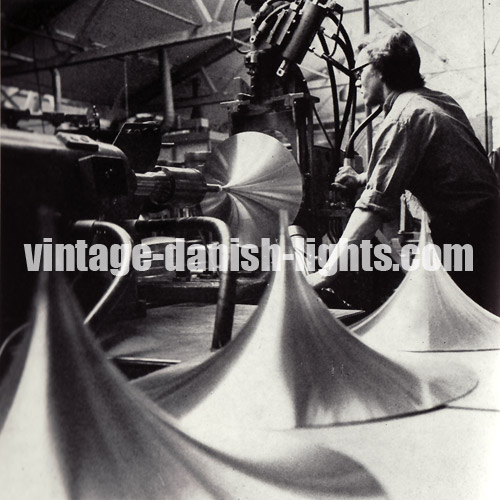
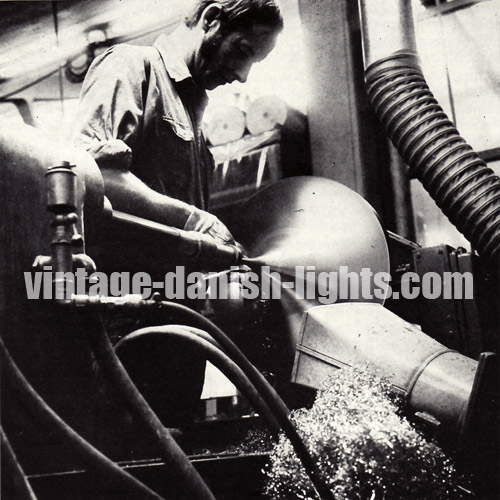
A flat, lifeless sheet of metal is given one almighty thump on an automatic power press [pictured in the first image below], surface-ground to produce an absolutely smooth texture [second and third images below], spray-painted to ensure a superior finish [fourth image], and finally, stacked ready for packing [fifth image].
When the Fog & Mørup brand was discarded following the company’s merger with Lyfa at the end of the 1970s, the Semi was one of just a handful of F&M lights to remain in production, marketed under the Lyfa brand. After the merged Lyfa-Fog & Mørup was taken over by mass-market lighting producer Lyskaer in the early 1980s, production of the Semi continued under Lyskaer branding, and in the 1990s the light appeared under Horn Belysning branding when Lyskaer was taken over by that company. Horn was itself taken over in 2005 by Nordlux of Ã…lborg, where the Semi is not currently in production.
UPDATE: An alert reader tells us that the Semi is currently in production by Copenhagen-based lighting producer Gubi. He also mentions having seen copies of the light by another manufacturer, which is a useful reminder that not everything that looks like a Semi is in fact a Semi. In a genuine Semi the lamp’s height exactly matches its radius (that is, half its diameter), and the diameter will be 38cm, 47cm, 60cm or 70cm. The only exception is the smallest Semi, a late 70s F&M production which has a diameter of 25.7cm and a height of 14.2cm, 1.35cm taller than it would be under the usual 2:1 ratio. Most unauthorised copies are foreshortened in the height proportion, possibly making them easier and therefore cheaper to produce but reducing the tapering elegance of their form.