Month: June 2010

  • Lyfa’s iF Product Design Awards

    Lyfa’s iF Product Design Awards

    The International Forum (iF) Product Design Awards have been presented annually since 1953 to products deemed by an international committee of experts to be of outstanding excellence in design. Several Lyfa lights received iF Product Design Awards in the 1960s and 1970s:


    • 1967 Pendel P523 pendant light, design Bent Karlby
    • 1969 Glastop pendant lights, design Eva Koppel (Nils Koppel, the lights’ co-designer, is not mentioned in the citation)
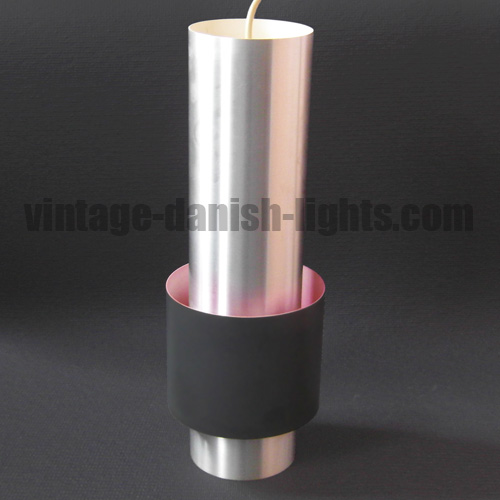
    • 1969 Kegle pendant light (below), designer unspecified

    Lyfa Kegle

    • 1971 Super-egg pendant lights, design Piet Hein
    • 1973 Turbo II pendant light, design Louis Weisdorf
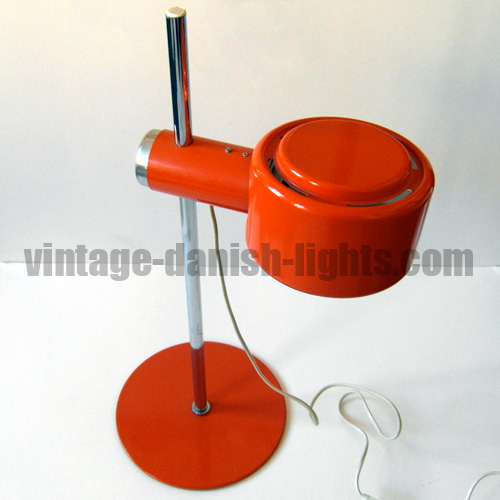
    • 1975 Piccolo floor light, table lamp (below) and wall light, designer unspecified

    Lyfa Piccolo

  • F&M Orient lookalikes from the UK

    F&M Orient lookalikes from the UK

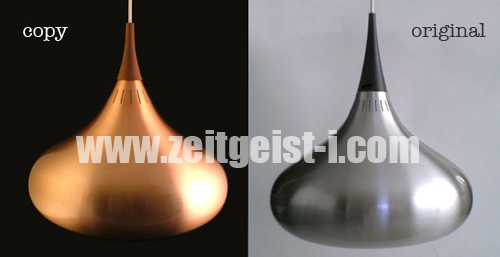
    The paradigm-changing originality of 1960s and 1970s Fog & Mørup light designs and the high cost of their uncompromisingly top-quality production led to countless cheap imitations. Many copyists used the F&M originals as inspiration rather than making direct counterfeits, but Nic at Zeitgeist Interiors has drawn our attention to the existence of some (vintage-produced) very close copies of Jo Hammerborg’s Orient.

    Fog and Morup Jo Hammerborg Orient copy and original

    Like Fog & Mørup’s original Orient, the copies were produced in both copper and aluminium versions. Nic sent us the images above and below of a copper copy alongside a genuine F&M aluminium Orient, and says: “You’ll see that the wooden cap is less well-fitted and much smaller on the copy, and that the slots are longer and fewer. It doesn’t show quite as well, but the shape of the copy puts more emphasis on the ‘bulging’ part of the lamp, with the gradient from the top half to the bottom half being more marked in its curvature.”

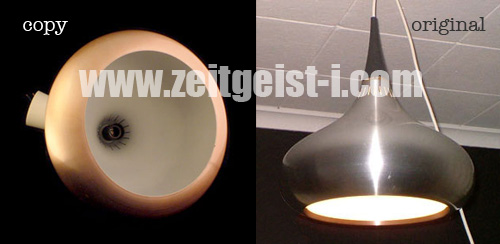
    Fog and Morup Jo Hammerborg Orient copy and original

    The most obvious difference, however, lies at the opening to the lamp’s body, where the original F&M version has a folded-back lip on the rim edge. The copy has no such fold and simply terminates at the rim. The hole is also a different size, so the plastic diffusers (removed for the photos) are not interchangeable between the original and the copy. Nic also notes that whereas genuine F&M Orients come with a rosewood cap in the copper version and an ebonised wood cap in the aluminium version, he has seen at least one copy aluminium version with a plain, non-ebonised wood cap.

    Nic says he has found these close copies only in the UK. Certainly we ourselves have never seen them in Denmark in 10 years of buying there, and our ever-vigilant Danish friends Sune and Claus confirm that they have never seen them in Denmark either.

    Could they have been produced outside Denmark by an official subcontractor? In the 1960s and 1970s Fog & Mørup sales to Europe and the United States were by export from Denmark, but some lamps were made under licence at Yamagiwa in Japan for the Far East market. But the many small (but significant) design differences and the considerable difference in quality suggest that they are very unlikely to be part of that licensed Japanese production, and Nic’s conclusion – with which we concur – is that they are almost certainly counterfeit copies.

    With many thanks to Nic at Zeigeist Interiors.

  • Zenith is Hammerborg, not Henningsen

    Zenith is Hammerborg, not Henningsen

    One of the most frequently misattributed Fog & Mørup lights is the Zenith, pictured below, whose designer is often given as Simon P Henningsen, son of that most celebrated of all Danish lighting designers, Poul Henningsen (aka PH). In fact the Zenith is a highly characteristic 1960s Jo Hammerborg creation, one of an extended series in which he explored the same basic structure in many varying proportions of height and width. None of Simon Henningsen’s light designs were produced by Fog & Mørup – all four of his creations in circulation today (the Tivoli Havelampe, the Divan 2, the Kassablanka and the Nippon) were made by Lyfa.

    Fog and Morup Jo Hammerborg Zenith

  • Hillebrand, not Bent Karlby for Lyfa

    Hillebrand, not Bent Karlby for Lyfa

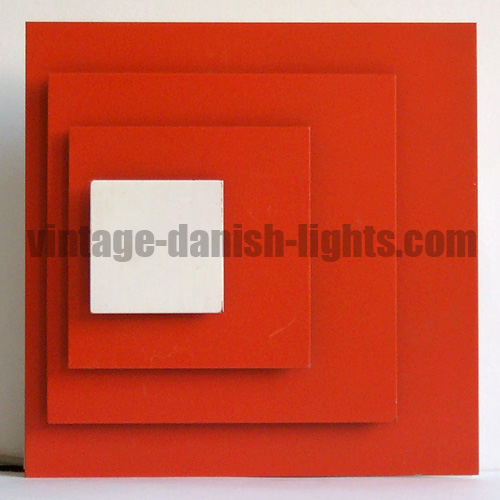
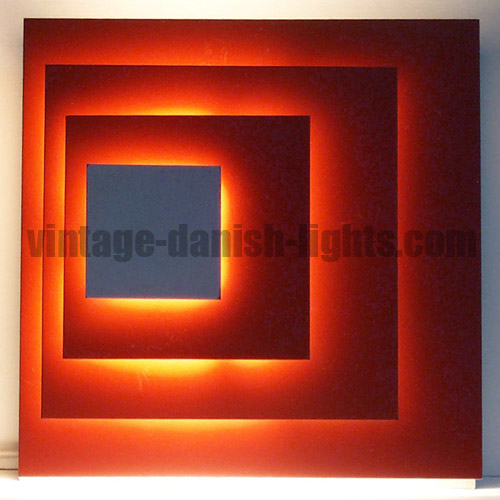
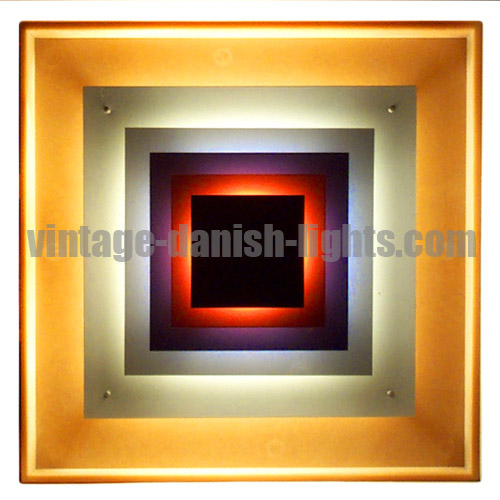
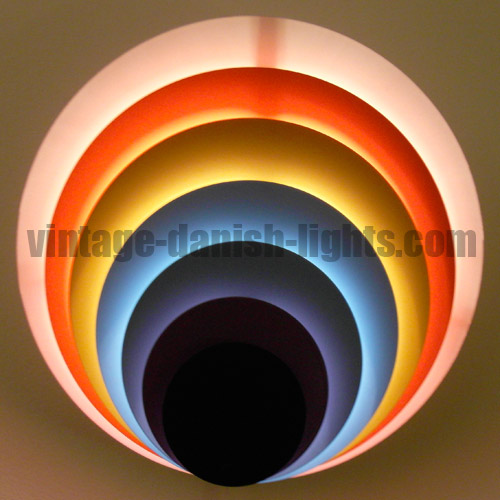
    With its structure of concentric metal squares and the light effects produced by the overlapping layers, it is perhaps unsurprising that the red and white wall light pictured in the first two images below is sometimes attributed to Bent Karlby for Lyfa, whose Kvadrille and Påfugl (Peacock) lights can be seen in the subsequent images. In fact the red lamp was produced by German lighting manufacturer Hillebrand. We don’t know the designer – if anyone does, we’d love to know: just click on the title of this article and leave a comment.

    Hillebrand wall light

    Hillebrand wall light

    Lyfa Bent Karlby Kvadrille wall light

    Lyfa Bent Karlby Pafugl wall light

  • Ole Panton and the Seks-tre-pendel

    Ole Panton and the Seks-tre-pendel

    One of the more elusive lights produced by Lyfa in the 1960s is the Seks-tre-pendel (pictured below, left), an unorthodox creation by Ole Panton. Born in Fyn, Denmark in October 1938 when his brother Verner was 12 years old, Ole followed in his sibling’s footsteps to became an architect and designer, and initially made his mark in the design of children’s playgrounds. His first commission was for Bispebjerg Hospital’s child psychiatric clinic, where he created what was considered to be an entirely new type of playground, offering inspiration for both children and their educators.

    In the mid 1960s, together with Louis Weisdorf, Ole Panton helped to found Det Lille Teater, a children’s theatre in Copenhagen. The pair led the refurbishment and decoration of the theatre premises in Lavendelstraede, putting to use seats that had been removed from the Glassalen in Tivoli Gardens and were about to be thrown away. It is an interesting coincidence that Panton’s Seks-tre-pendel and Weisdorf’s Ekko (below, right) were both produced by Lyfa in the late 60s, and that the two lights were jointly advertised. The only mention of lighting in Weisdorf’s account of the creation of Det Lille Teater is that Louis Poulsen donated a number of PH lamps to the project, but the unconventional and theatrical character of these two lights leads us to wonder whether their origins might lie in the Lille Teater project.

    Lyfa Seks-tre-pendel Ole Panton Ekko Louis Weisdorf

  • Louis Weisdorf, Wiesdorf or Weissdorf?

    Louis Weisdorf, Wiesdorf or Weissdorf?

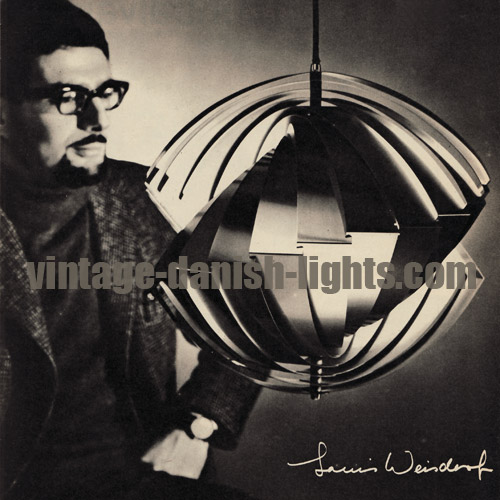
    The name of the Danish architect who in the 1960s designed several lights that are today considered to be amongst Lyfa’s most interesting and collectable – including the Turbo, the Facet-Pop, the Ekko, the Multi-Lite and the Konkylie (pictured below with its distinguished creator) – can be found with many different spellings across the internet. Confusion over the order of the first two vowels and whether the s and the f should be single or double has given rise to the variations Louis Weissdorf, Weissdorff, Weisdorff, Wiesdorf, Wiessdorf and Wiessdorff. The correct form, as demonstrated in the architect’s signature, is Louis Weisdorf.

    Lyfa Konkylie Louis Weisdorf

  • Tips for buying vintage Danish lights

    Tips for buying vintage Danish lights

    Every area of vintage/antique design collecting has pitfalls and dangers, and vintage Danish lighting is no exception. Here’s our five-point guide to making sure that your investment is sound and that you’re not throwing your money away.

    1. Check that the light really is what the seller claims it is. While a few unscrupulous sellers do deliberately set out to mislead, the overwhelming majority of false attributions come from sellers who simply repeat unsubstantiated information from other sources. Sometimes the mistake is the attribution of an incorrect designer or manufacturer to a genuinely collectable light, in which case its value may not be significantly affected by the mistake. A greater danger to your investment arises when a lookalike copy of a valuable original is offered as the original light it’s been copied from. Fog & Mørup light designs from the 1960s and 70s, for example, were widely copied for a market eager to adopt but unable to afford the company’s innovative but expensive productions, and it’s not unusual today for these poorer-quality lookalikes and imitations to be attributed to F&M, often citing Jo Hammerborg as designer. Both kinds of mistake have a tendency to ripple out across the internet and even appear in sources that might be thought to be reliable, such as auction house listings and design encyclopedias. For reliable information, refer to our own directory of vintage Danish lighting, which is compiled entirely from primary sources such as original manufacturers’ advertisements and product catalogues.

    2. Check the light’s condition carefully, and if buying online ask the seller for a condition report if none is provided. The resale value of a vintage light drops significantly with scratches, rust, dents, bends and other damage, but some sellers do not take account of this when setting their own selling price. Beware of terms like patina being used as a euphemism for damage. Patination is a natural outcome of age and normal use in materials like wood and copper, and is not the result of insult, injury or exposure to inhospitable conditions. Also beware of vague phrases like “as you would expect in a lamp this age”. In fact there is no reason why you shouldn’t expect the bodywork of a 1960s or 1970s pendant light to be in near perfect condition if it hasn’t been damaged in transit between one installation and another: there are usually no moving parts to create “wear” (another word to be wary of). Look out too for interventions such as repainting, which will destroy the value of all but the most exceptionally rare vintage lamps and significantly reduce even those.

    3. Make sure there are no missing parts. Some lights, for example Verner Panton’s Flowerpot for Louis Poulsen, and Jo Hammerborg’s Saturn and Erik Balslev’s Radius for Fog & Mørup (pictured below), have parts that have to be removed to replace the bulb. It’s not unusual for these to go missing altogether, so check before buying.
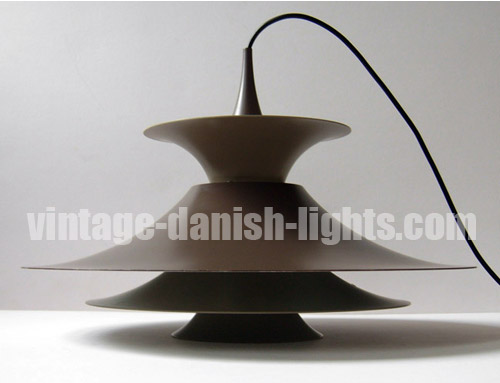
    Fog and Morup Radius E Balslev

    4. If you’re planning to put your vintage light to use at home, make sure it’s safe and legal to do so. The electric components and wiring of many vintage lights are in poor condition, so ask your seller whether the components have been fully dismantled, checked, and where necessary replaced. In the UK, legislation introduced in 2005 requires metal-bodied lighting installed directly into the mains to have three core wiring and bulb-holder, but vintage Danish lighting nearly always comes with a two-core set-up, so ask your seller to convert. Bear in mind, however, that removing original components may have a small impact on the light’s value, especially if it is done using components that don’t match the style of the originals.

    5. Finally, check that the light is indeed a vintage original and not a later production or reissue. Many vintage designs are still in production or back in production by a different manufacturer. These will not maintain and increase their value in the same way as an original vintage example.

  • The Louis Poulsen Bornholmpendel

    The Louis Poulsen Bornholmpendel

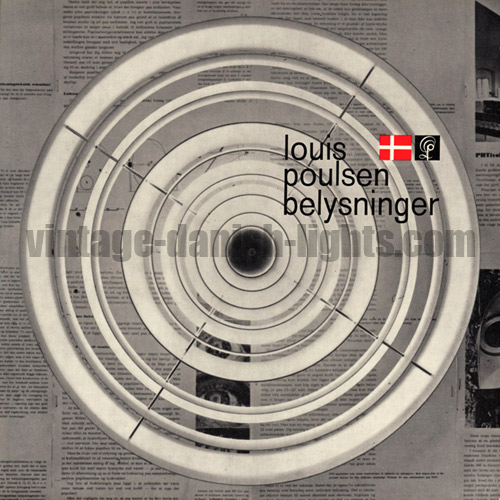
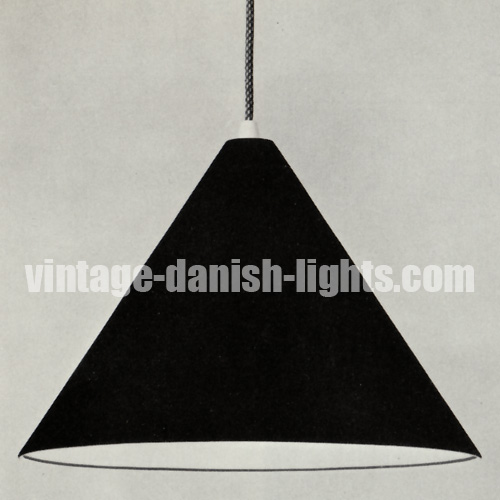
    The Bornholmpendel is rarely seen today, but in 1967 it was chosen by Louis Poulsen to feature on the front cover of its product catalogue (see below). The light was designed in 1964 by architects Finn Monies and Gunnar Jensen as part of a project creating furniture and interiors for Bornholm shipping company Dampskibselskabet af 1866, and was subsequently put into general production by Poulsen. With its open structure and a diameter of 47cm, the Bornholmspendel was a natural choice for public spaces, and the rare occasions when it appears on the market today tend to follow the renovation of a church or similar building.

    Louis Poulsen Bornholmpendel