Category: General comments

  • Changes ahead in the market for Jo Hammerborg lights

    Changes ahead in the market for Jo Hammerborg lights

    One of the features that has driven the increasing popularity of 60s and 70s Fog & Mørup lighting as a target for collectors – along with the consistently high quality and design excellence of the individual lights themselves and the cohesiveness of the F&M brand as a whole during this period – has been the fact that (with the exception of the Semi) the lights have never been reproduced. This has given the lights a scarcity value and has made them attractive to new collectors, who have not needed to study up on subtle historical design and production changes to be sure that they are buying a vintage model rather than one made last year.

    But this is soon to change, as a little bird tells us that a number of Jo Hammerborg’s Fog & Mørup light designs are to be reproduced, with the first of them due to become available within months. We expect a big shake-up in the market for vintage Hammerborg lights to follow.

    The precise effects that the arrival of these new productions will have on the vintage market will depend on several factors, amongst them the degree to which they match the quality standards of the originals and whether any aspects of the designs have been changed to accommodate modern production methods and materials and/or perceived changes in public tastes.

    If the new lamps are similar in appearance and quality to the originals, one effect may be a drop in demand for originals that are in less than excellent condition, as a proportion of the buyers who currently purchase Hammerborg designs purely for their aesthetic and functional qualities (and not as collectables) opt for new versions in preference to substandard originals. Lamps with visible dents, scratches or rust, with missing parts such as anti-glare louvres or acrylic plates, or that have been subjected to repainting are all likely to become relatively less attractive to these buyers. Those in the very best condition, meanwhile, are likely to hold or increase their value as awareness of the lights is brought to a wider audience, a proportion of whom will seek out originals that will maintain their value rather than buy a reissue.

    On the other hand, if the reissued lamps differ significantly from the originals in quality and/or design features, the effect they might have on the vintage market is harder to predict. While awareness of Hammerborg lamps amongst the general population may grow, the understanding of what buyers expect individual lights to look and feel like may become less clear-cut. Buyers with access to both old and new versions (who will of course tend to be those based in Denmark) may compare the two and choose to purchase vintage originals, leading to a local boost in the vintage sector. But for the wider international market, where people are less likely to have the opportunity to experience both versions “in the flesh”, a poorer-quality reissue may lead those who come across it to have a distorted understanding of the high quality standards of an original F&M production.

    While we wait to see what actually emerges from this new project, we have been speculating amongst ourselves about the identity of the first Hammerborg light to be reissued. Want to join the guessing game? Take part in our poll!


  • Your favourite Louis Weisdorf light design

    Your favourite Louis Weisdorf light design

    It’s been some time since our last blog post, but we haven’t been idle in the meantime, and our main project has been to give our sister site Classic Modern a complete redesign and makeover. We’ve also been making progress on something that’s been bubbling away in the background for a couple of years now – a series of posts on the background to Louis Weisdorf’s lights. They will reveal many fascinating insights into the architect and his work, including which of his light designs is his own favourite. Meanwhile, we’d like to know what YOUR favourite Weisdorf light is. Vote in our poll below, and compare your choice with Weisdorf’s own when the profile is ready!

    Louis Weisdorf lights

    [polldaddy poll=5510807]

  • In memory of Claus Bolby (1944-2011)

    In memory of Claus Bolby (1944-2011)

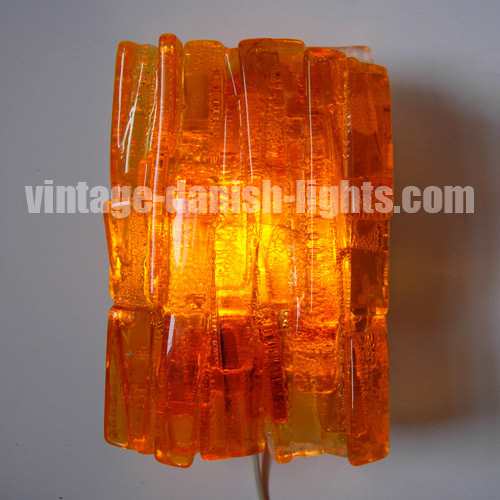
    Today we heard the sad news that veteran Danish lighting designer and producer Claus Bolby, founder of Cebo Industri and creator of the popular acrylic light series Symfoni and Veega (pictured below), died last night after a long illness, his wife and lifelong business partner Jytte at his side.

    In memory of Claus Bolby by Sune Riishede

    Born in 1944, Bolby came to lighting design and production in his early 20s and remained active in the field until he became ill two years ago. He was not one to dwell on the past, and was amused to discover that his 1960s light designs had become popular collectors’ items and were undergoing a thriving trade in cyberspace. He and Jytte collaborated with vintage design dealer and journalist Sune Riishede to produce a profile of his 1960s and 1970s lighting for our sister site classic-modern.co.uk, which led shortly afterwards to a feature on Danish TV programme Hvad er det værd?


    For Bolby’s many friends, this clip offers some solace today, replacing the image of his painful battle with illness with a memory of the smiling and charismatic man amongst his colourful creations.

  • Finn Juhl and the drivers of vintage value

    Finn Juhl and the drivers of vintage value

    The perceived value (and so the price) of a vintage Danish light is usually fairly closely related to its historical retail price. Broadly speaking, the more expensive the light originally was, the higher the value placed upon it today as a collector’s item. There are good reasons for this. The lights that were most expensive to buy in the 60s and 70s were those that were produced to the highest standards of quality and/or made from the most expensive materials and/or the most costly to develop and produce because of their complexity or the amount of manpower employed in the process. The high-quality design and production specifications of such lamps is what makes people prepared to pay higher prices for them today, just as it was when they were originally retailed.

    Finn Juhl light for Lyfa

    There are, however, exceptions to this rule, which reveal some of the other factors driving vintage value. Finn Juhl’s mid-1960s Lyfa light is a good example. The design, with its tilting shade, was available in wall, table and pendant versions, the latter (pictured above) retailing at the end of 1966 for a mere 134 Danish krone for a 27cm diameter version and 150 kr for a 34cm version. At the same date, retail prices for other Danish lights included 395 kr for the Fog & Mørup Hekla, designed by Jon Olafsson & Petur B Luthersson, 439 kr for Fritz Schlegel’s Lyfa pendant, 236 kr for Verner Panton’s Moon pendant, produced by Louis Poulsen, and 333 kr for Poulsen’s PH table lamp, designed by Poul Henningsen.

    Today a collector might expect to pay something in the region of one UK pound for each krone of the original price for all the abovementioned lights – with the exception of the Finn Juhl, for which the asking price is likely to be closer to 10 UK pounds for each original krone.

    What lifts today’s price for this light so far above those of its contemporaries? The simple answer is its scarcity. It was not in production for many years and seems not to have sold in very large quantities, so supply today is very limited in comparison with some of the other lights mentioned – some of which are still being manufactured today. Meanwhile, Finn Juhl’s status as one of the great Danish designers and the fact that the Lyfa light is the only light he designed means that demand is high. Thus the intangible forces of demand and supply lift the price of the light onto a plane of its own. Unless, of course, someone discovers a huge cache of unsold stock in an old lighting warehouse.

  • The PH lighting manifesto part 2

    The PH lighting manifesto part 2

    Following on from last week’s post, which you can read here, we continue our translation of Bo Bedre’s November 1966 feature offering Poul Henningsen’s thoughts on lighting the home.

    Poul Henningsen by Jens Bull

    About lighting contrasts
    The eye cannot of course be prepared to respond at two levels of sensitivity at once. In a brilliantly lit kitchen, where the eye has adapted itself by closing down its response to light a little, it can be almost impossible to see what lies, for example, at the bottom of a deep, dark drawer. Thus it is much easier to see where the contrasts are not too great.

    About pale floors
    It is important to remember that light that falls down will diffuse up again in the form of glare from bright surfaces – pale floors or carpets, light table surfaces. It was bright fabrics that made sitting around the family table with a kerosene lamp so nice. A dark ceiling above, and pale floors and table surfaces beneath!
    Oh, certainly we have done the opposite for many years, but this is the right thing and the most comfortable.

    About dark walls
    In a dark room – with dark walls, furniture etc – you can make do with less light. It does not take much to provide adequate contrast. In a room with bright colours it takes relatively more light to achieve the same degree of contrast.
    Luminous efficiency consists of contrasts – if there were no contrast of things, one could not perceive them. But the contrast must never become so great that light dazzles.
    I once made a completely dark kitchen. We still have one today in our house. Not black now, but there is very dark woodwork and the counter top is laboratory stained. There’s not much light there, but it is good light. Warm light. There is no discomfort when you move your eyes from the intensely lit stove to the darker sections. And it keeps both food and cooking a good healthy colour.

    On the strength of lighting
    We must be careful not to fall into light addiction just because lighting equipment manufacturers increase the numbers in their tables year on year. Once it was said that a power consumption of 10 watts per square metre was sufficient. Now it is as high as 20 to 40 watts. In the lighting set-up in my own room I should I think have a total of 400 watts. I would rather have 250 watts, but my wife and I have agreed on 350 watts. This is equivalent to somewhere between 10 and 15 watts per square metre in large and small lamps.

    Large and small bulbs
    A 25 watt or 40 watt bulb gives a warmer and a more pleasant light than a 100 watt bulb. If you must use the whiter light of the larger bulb, you can place it behind a screen with warm colours – or you can make sure that the light falls on a surface – such as a table – with warm, light colours. The human eye is more familiar with the warm colours, and we thrive better with them.

    About lamps – and ladies’ hats
    There are unfortunately architects creating ladies’ hats instead of lampshades – and who have been happy to stretch an empty 10cm tin and call it a lamp. I wish that architects would think more about function than making “interesting” shapes.
    But that will probably only happen when the consumers themselves break out of their traditional perception of light and begin to make demands for quality on those manufacturers who are more or less forced to fabricate on demand.
    And that will happen only when consumers close their ears to the publicity drums, which have only the echo of the sales tills in mind.

  • Poul Henningsen’s lighting manifesto

    Poul Henningsen’s lighting manifesto

    In November 1966 Danish homestyle magazine Bo Bedre published a feature by Kirsten Bundgaard in which Poul Henningsen offered his thoughts on lighting in the home. We have translated these pearls of wisdom from their original Danish (below).

    Poul Henningsen by Jens Bull

    About the colour
    It is a misconception that artificial light must be an imitation of daytime sunlight, for it is not intended that day and night should be the same. We do not thrive on it.
    Admittedly, we have lights at night – we humans are frightened by total darkness. But when our forefathers huddled around the bonfire in the evening, it was for the heat, including the visually-perceived warmth of the fire flames, which provided security and protection against the darkness around it.
    Warm light changes the surroundings – the “cold” bluish colours are not as prominent. Man thrives better.

    About fluorescence
    The fluorescent tube is still, in its present form, a misunderstanding. Certainly it is strong: it casts bright light uniformly across the room. But it changes the surroundings in an erratic manner.
    Girls are not pretty in fluorescent lighting. However, they are lovely in the glow of an incandescent lamp or candles.
    Is there anything worse than coming into a house where the rooms are lit nicely, but a numbing light shock emanates from a pair of unforgiving fluorescent lights whenever the kitchen door opens? This is not a nice scenario for a family home!

    On the distribution of lamps
    Proper lighting is simply having as much (or as little) light as you need and feel comfortable with – and having it in the right places.
    You have to have many lights in a house, and you should feel a new lighting experience with each lamp. Lamps should be exciting.
    Light in a work area can obviously be brighter than elsewhere – but the rest of the room should not lie in the dark. There must still be small bright islands around, but with slightly more subdued areas in between.

    About as little light as possible
    The ugliness in the world is an over-lit space. Man cannot thrive in a sea of light, yet we are increasing the light-barbarism from day to day.
    This is probably because of the old fallacy that you see more and better in a room that is bright and dazzlingly illuminated. This is not, however, the case, due to the human eye’s ability to adapt. The eye automatically reduces its retinal sensitivity when exposed to strong light, whereas it becomes more sensitive in a subdued light.
    Sight does not improve because the illumination is increased – you just guard against the intense light by reducing the eye’s sensitivity. Think of the products that ancient craftsmen were able to make – small, meticulous things like filigree work – just by the glow of a candle…

    See next week’s post for part 2 of this feature.

  • The forgotten art of Oluf Gravesen

    The forgotten art of Oluf Gravesen

    Danish advertising for items of domestic design in the 1960s and 1970s often followed a very specific format. The featured product would be photographed in a room setting together with items by other manufacturers that were generally considered to be amongst the most prestigious and desirable designs of the time. These secondary items were not identified in the advertisement and were not themselves being promoted; rather, their presence was intended to signal the prestige and desirability of the advertiser’s own product.

    Fog

    Thus Fog & Mørup, Lyfa and Louis Poulsen lights featured in many different furniture producers’ room settings, the example above being an advertisement for Ryesberg Møbler chairs by Illum Wikkelso (featuring the F&M Formland), and the following three being for G Thams-designed seating at Vejen Polstermøbelfabrik (first with the F&M Milieu and Verner Panton’s Topan for Louis Poulsen, and then with Lyfa’s Konkylie) and a Matador sofa group at Eran Møbler (with the F&M Hekla).

    Fog

    Lyfa

    Fog

    Conversely, furniture by manufacturers including Fritz Hansen, France & Son, Getama and the like often formed the background room setting for Fog & Mørup’s own advertisements. Most of the items that were called into action for this supporting role are easily identified today, but an exception exists in the case of an artist called Oluf Gravesen, whose artworks were employed by Fog & Mørup and others. Gravesen’s work went unrecognised in this context for decades until it was spotted recently by our friend and research collaborator Sune Riishede in two late 60s images – one an F&M Diskos advert and the other a picture of a Danish Furniture Manufacturers’ Association display at the London Earls Court International Furniture Show (both reproduced below).

    Oluf

    Oluf

    Sune had become close friends with Oluf Gravesen when both moved to Copenhagen after being at boarding school together in the late 1950s. In 1961 the 18-year-old Gravesen became the youngest person to be admitted to the Danish Royal Academy’s Spring Exhibition at Charlottenborg, exhibiting three small scrap metal reliefs. A successful solo exhibition at Den Permanente in the mid-60s brought his work to the attention of Copenhagen’s stylists and led to its inclusion in room settings such as those above. Later he worked on his artworks, all made entirely of nails, in Paris, London and New York. Gravesen’s exile meant he was not widely known in Denmark, so when he returned home from New York in the mid-1980s with a deadly disease, his tragically premature death was marked only by his family and closest friends and came, in the words of Pittsburgh’s Concept Art Gallery, “before he could see the influence his work would have on the late 20th and early 21st century New York art scene”.

    Oluf

    Photograph of Oluf Gravesen reproduced by kind permission of Ray Dean


    UPDATE 26 December 2011: Our sharp-eyed friend Sune Riishede has spotted another of Oluf’s artworks, this time featuring in a 1966 Fog & Mørup advertisement for Jo Hammerborg’s Trombone table lamp. Sune tells us: “I remember that Oluf had a short period in the early 1960s where he would penetrate a thin metal sheet with nails to create a landscape of holes, and also to hammer a shape in the metal surface. I imagine that this one belonged to interior designer Bent Kilåe’s collection, since I never saw those works again.”

    Oluf

  • The uniquely Danish concept of hygge

    The uniquely Danish concept of hygge

    From time to time we hear someone in Denmark describing a vintage light – usually one that gives out a warm glow, such as Claus Bolby‘s Veega (pictured below) – as “hygge”, and over the years we have come to understand that to Danish people this word means something culturally specific that is difficult to translate in a single word. “Cosy” or “comfortable” are the translations most often given, but these words don’t convey the whole meaning.

    Claus Bolby Veega wall light

    The 1960s publication Design from Denmark, forerunner of the Design from Scandinavia series, attempts a more comprehensive definition. “A Danish word which you will never be able to translate,” it says, “is hygge. It means ease, comfort and contentment all added together – yet somehow a lot more than that. The recipe includes fun, food, fairy-tales and friendship. How can such a snug little concept fit in with memories of the violent past and with the demands of the modern world? Can a country be both cosy and competent in this bustling century? People here are sure it can – people who work hard to high standards and yet know how to relax and be cosy in their free and easy democracy where you can cycle right past the King’s front door.”

  • Tips for buying vintage Danish lights

    Tips for buying vintage Danish lights

    Every area of vintage/antique design collecting has pitfalls and dangers, and vintage Danish lighting is no exception. Here’s our five-point guide to making sure that your investment is sound and that you’re not throwing your money away.

    1. Check that the light really is what the seller claims it is. While a few unscrupulous sellers do deliberately set out to mislead, the overwhelming majority of false attributions come from sellers who simply repeat unsubstantiated information from other sources. Sometimes the mistake is the attribution of an incorrect designer or manufacturer to a genuinely collectable light, in which case its value may not be significantly affected by the mistake. A greater danger to your investment arises when a lookalike copy of a valuable original is offered as the original light it’s been copied from. Fog & Mørup light designs from the 1960s and 70s, for example, were widely copied for a market eager to adopt but unable to afford the company’s innovative but expensive productions, and it’s not unusual today for these poorer-quality lookalikes and imitations to be attributed to F&M, often citing Jo Hammerborg as designer. Both kinds of mistake have a tendency to ripple out across the internet and even appear in sources that might be thought to be reliable, such as auction house listings and design encyclopedias. For reliable information, refer to our own directory of vintage Danish lighting, which is compiled entirely from primary sources such as original manufacturers’ advertisements and product catalogues.

    2. Check the light’s condition carefully, and if buying online ask the seller for a condition report if none is provided. The resale value of a vintage light drops significantly with scratches, rust, dents, bends and other damage, but some sellers do not take account of this when setting their own selling price. Beware of terms like patina being used as a euphemism for damage. Patination is a natural outcome of age and normal use in materials like wood and copper, and is not the result of insult, injury or exposure to inhospitable conditions. Also beware of vague phrases like “as you would expect in a lamp this age”. In fact there is no reason why you shouldn’t expect the bodywork of a 1960s or 1970s pendant light to be in near perfect condition if it hasn’t been damaged in transit between one installation and another: there are usually no moving parts to create “wear” (another word to be wary of). Look out too for interventions such as repainting, which will destroy the value of all but the most exceptionally rare vintage lamps and significantly reduce even those.

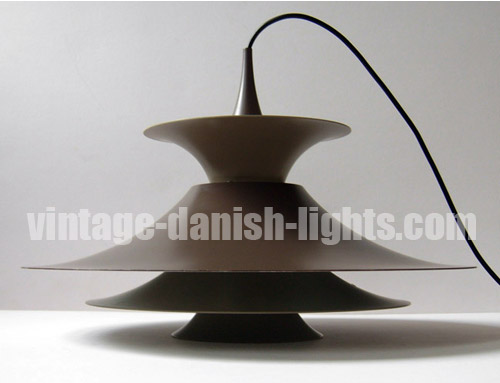
    3. Make sure there are no missing parts. Some lights, for example Verner Panton’s Flowerpot for Louis Poulsen, and Jo Hammerborg’s Saturn and Erik Balslev’s Radius for Fog & Mørup (pictured below), have parts that have to be removed to replace the bulb. It’s not unusual for these to go missing altogether, so check before buying.

    Fog and Morup Radius E Balslev

    4. If you’re planning to put your vintage light to use at home, make sure it’s safe and legal to do so. The electric components and wiring of many vintage lights are in poor condition, so ask your seller whether the components have been fully dismantled, checked, and where necessary replaced. In the UK, legislation introduced in 2005 requires metal-bodied lighting installed directly into the mains to have three core wiring and bulb-holder, but vintage Danish lighting nearly always comes with a two-core set-up, so ask your seller to convert. Bear in mind, however, that removing original components may have a small impact on the light’s value, especially if it is done using components that don’t match the style of the originals.

    5. Finally, check that the light is indeed a vintage original and not a later production or reissue. Many vintage designs are still in production or back in production by a different manufacturer. These will not maintain and increase their value in the same way as an original vintage example.

  • A dangerous time for lights

    A dangerous time for lights

    The most perilous time in a vintage lamp’s lifecycle starts when it leaves its original home – where the worst it’s likely to have suffered is a layer of dust, a few spots of ceiling paint and a coating of cigarette smoke. As it embarks upon the journey towards its next long-term installation it’s at risk of being bashed, scratched, exposed to damp, or even losing some of its parts.

    Although a growing number of antique/second-hand dealers and charity/recycling shops do treat such lamps with the respect they deserve, many others are still piling them high in a tangled jumble without a care for their well-being. And a sad destiny awaits those that end up in one of the farmers’ barns that double as part-time junk shops if they don’t sell quickly – rust will set in and eat them alive. They will be lucky to escape without damage. Fortunately and perhaps surprisingly, many do.


    Second-hand shop in barn

  • Is this why Danes love lights?

    Is this why Danes love lights?

    With a population of less than 5.5 million, Denmark surely produced more lights per head in the 50s, 60s and 70s than anywhere else in the world. Many were made for export, but vast numbers were sold within the country, reflecting the importance that was (and still is) placed upon lighting in ordinary Danish homes.

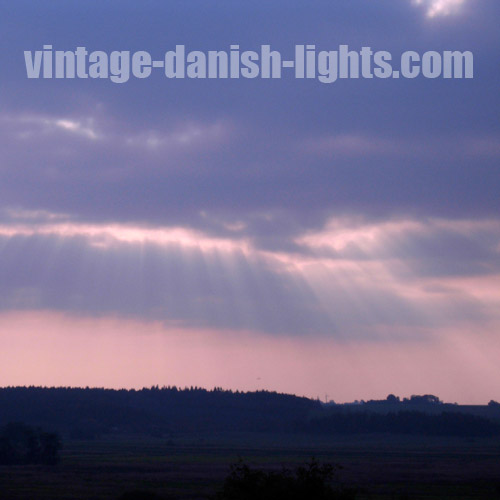
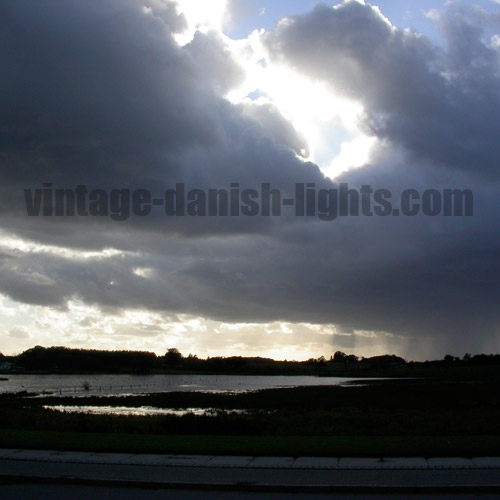
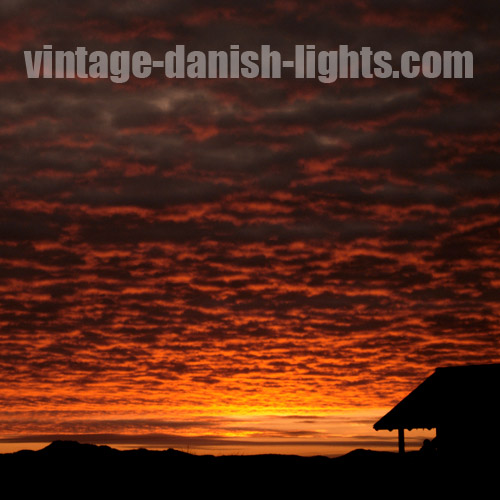
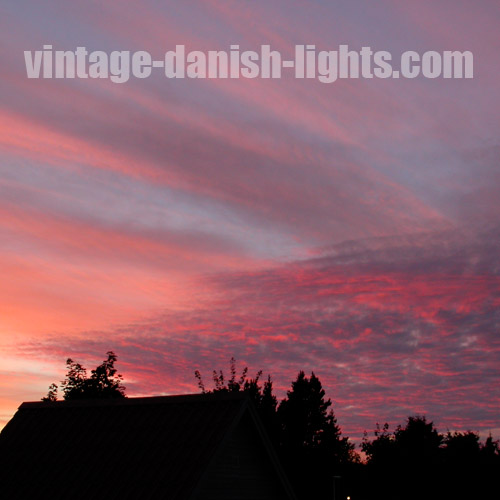
    As regular visitors to the country, we have an entirely unprovable theory about the reason for this special emphasis. We believe that the dramatic effects in light and shade that result from Denmark’s huge skies, open landscapes and northerly position cause its inhabitants to be acutely aware of the powerful impact of lighting and its ability to define an environment.

    In support of our thesis we offer a handful of the many Danish sky snaps we have taken over the years.


    Danish sky

    Danish sky

    Danish sky

    Danish sky

    Danish sky

  • Welcome to vintage danish lights

    Welcome to our brand new blog about and directory of vintage Danish lighting! We were inspired to create them by the many mistakes in attribution we see around the internet, and we hope they will play some part in putting the record straight.

    The directory covers several hundred vintage Danish lights from the 1960s and 1970s, and all the information comes from primary sources such as original advertisements and manufacturers’ product catalogues.

    The blog address is vintage-danish-lights.com, and the directory is at danish-lights.com. We hope you will visit us often!