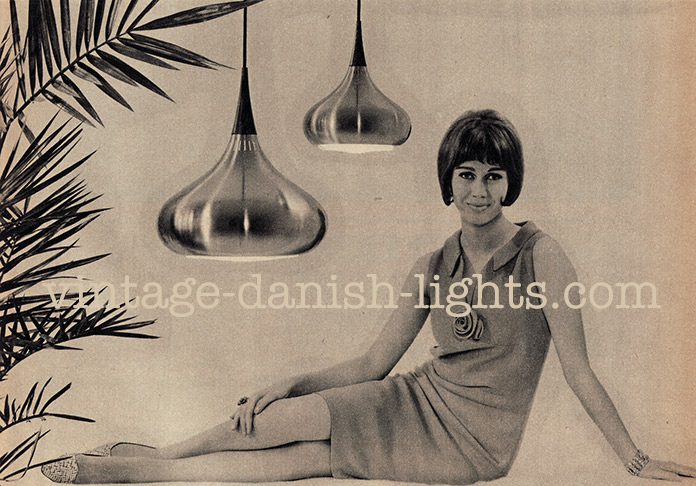
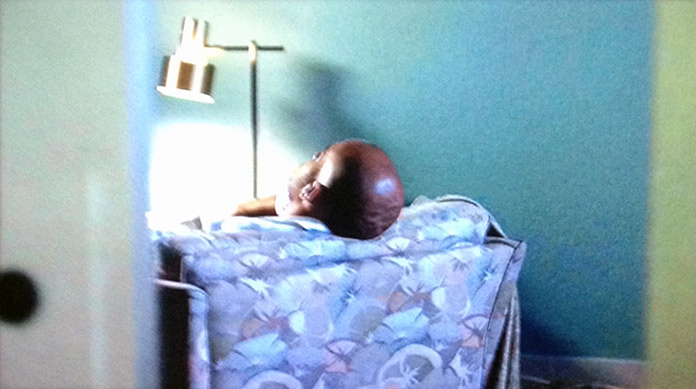
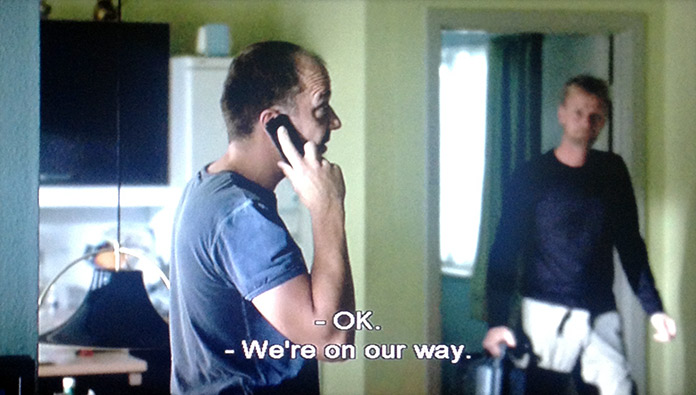
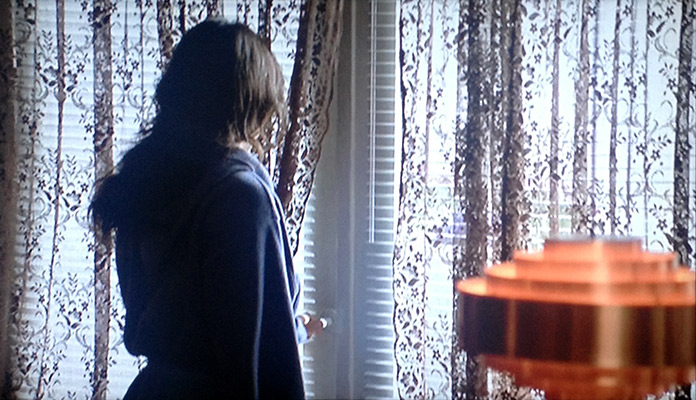
Since becoming addicted to The Killing and Borgen we’ve tried out a mixed bag of other Danish TV series, and most recently have been watching The Protectors (Livvagterne in Danish). The set designer is clearly a Hammerborg fan, which has provided an entertaining sideline to the main action as we compete to see who can spot the Hammerborg lights first. We’ve taken snaps of some of our finds – in order of appearance: the Lento, the Single and the Ultra.
Month: April 2013
-

Hammerborgs on film
-

Why Jo Hammerborg’s Orient is incomplete without its louvre
So the first Jo Hammerborg light reproduction has finally appeared, and the wisdom of the crowd has made itself apparent in our poll by correctly predicting that the chosen model would be the Orient.
We haven’t yet had the opportunity to see the new Orient except in the publicity photos issued by its producer Lightyears, so are unable to make any judgement about its quality or be certain about our impression that the rosewood finial in the new version appears to be a straight-sided cone rather than the tapered original which carried the curve of the domed body right up to the tip of the lamp.
But what is clear is that the Orients in Lightyears’ photos have no louvre/diffuser in place, and further investigation reveals that the company has omitted this feature in the new version.
Why does this seems like a fundamental oversight to us?
First of all, the louvre wasn’t an optional extra in the original Orient – it was designed, produced and sold as an integral part of the light, and was created specifically for the Orient. Price lists issued to Fog & Mørup retailers included a section entitled “Replacement parts of acrylic and louvres”, in which each replacement part was listed by the name of the light for which it had been created. For example, in the retailers’ price list for February 1967 we see:
Replacement parts of acrylic and louvres
…
Orient minor E5958 Dkr 5.25
Orient major E5959 Dkr 7.75
…Secondly, the louvre’s function is to filter and soften the light cast by the lamp. This isn’t about direct glare from the bulb – which is housed high enough within the dome-shaped body to be out of sight except when viewed from directly beneath the lamp – it’s about the overall quality of the light Jo Hammerborg intended to emerge from the lamp.
The fact that specific attention was paid at Fog & Mørup to the amount and quality of light emitted from a lamp is illustrated by the instruction in a Fog & Mørup catalogue not to use opalescent bulbs in Sophus Frandsen’s Fibonacci: “For the Fibonacci lamp only clear bulbs should be used, as anti-dazzling and the right distribution of light can only be obtained with the correct bulb. The lampholder is adjustable to the various bulb sizes, so that the distance to the shades can always be correct.”
This is not something Hammerborg was in any way careless or carefree about – as head of design at F&M his attention to detail was unparalleled in his day, and no feature – no matter how small or apparently insignificant – escaped his notice. Every F&M light created during Hammerborg’s reign displays the stamp of his meticulous approach. His relentless attention to detail included every component, both visible and concealed, and even the most apparently insignificant components such as bulbholders, studs and switches were designed specifically to fit with the F&M aesthetic and quality standards. It is this above anything else that defines the F&M brand during the period that Hammerborg was at the company.
But perhaps the outstanding feature of Jo Hammerborg’s own designs is the perfect harmony he achieved between form and function. In keeping with the modernist principles that informed his intellectual approach to design, his forms are sparse and elegant, free from any gratuitous decorative flourishes yet effortlessly beautiful from every angle, revealing in their economy and restraint his training as a silversmith at Georg Jensen.
Without the louvre, the folded-back lip on the Orient’s bottom edge becomes a decorative flourish. Hammerborg created it to support and restrain the louvre. Without the louvre the folded lip loses its purpose and the Orient loses some of its credentials as a modernist light. Furthermore, without the louvre the lamp has an unfinished look, and viewed from beneath seems naked.
The Orient was also an exercise in the use of different materials with contrasting qualities, textures and colours – a theme that runs through much of 20th century modernism and whose influence can still be seen in architecture today. Look, the Orient says, here are three completely different materials – copper, wood and plastic, and don’t they work well together?
Lightyears’ publicity for the new Orient claims that their reproduction is faithful to Hammerborg’s original design, but by excluding the louvre from the lamp they have removed a functional feature of the light and undermined both its aesthetic harmony and its intellectual underpinnings. They have forgotten, or failed to recognise, the fact that Hammerborg’s designs were the products of a perfectionist mind, conceived intellectually and produced with careful and deliberate attention to every detail.
But maybe it’s not too late for Lightyears to reverse this ill-advised decision. Changing their minds and getting the louvres made up wouldn’t require any alterations to the copper bodies they have produced and would be a fitting tribute to Jo Hammerborg’s genius.