Today we heard the sad news that veteran Danish lighting designer and producer Claus Bolby, founder of Cebo Industri and creator of the popular acrylic light series Symfoni and Veega (pictured below), died last night after a long illness, his wife and lifelong business partner Jytte at his side.
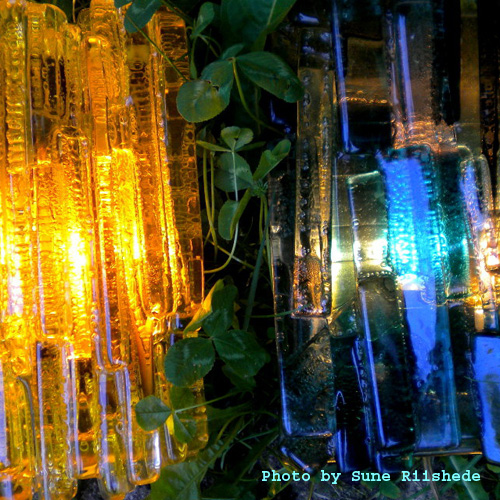
Born in 1944, Bolby came to lighting design and production in his early 20s and remained active in the field until he became ill two years ago. He was not one to dwell on the past, and was amused to discover that his 1960s light designs had become popular collectors’ items and were undergoing a thriving trade in cyberspace. He and Jytte collaborated with vintage design dealer and journalist Sune Riishede to produce a profile of his 1960s and 1970s lighting for our sister site classic-modern.co.uk, which led shortly afterwards to a feature on Danish TV programme Hvad er det værd?
For Bolby’s many friends, this clip offers some solace today, replacing the image of his painful battle with illness with a memory of the smiling and charismatic man amongst his colourful creations.
Month: June 2011
-

In memory of Claus Bolby (1944-2011)
-

A tale of two Topans: the Pendant & the Spot
Verner Panton’s futuristic 1959 Topan light design for Louis Poulsen has rarely been out of the limelight in its more than 50 years of existence. Frequently copied and never out of style, the clipped sphere has stood the test of time and is an undisputed design classic.
But how many people know that early versions of the Topan were divided into two models – the Topan Pendant (Topanpendel) and the Topan Spot (Topanspot), both available in a choice of polished aluminium or light grey? The difference between the two models was in the strength of the bulb they were designed to take, the Topan Pendant using a 75 watt bulb and the Topan Spot a 100 watt.
Also largely forgotten today is the fact that both Topan models were available either with or without a metal grille to shield the bulb. Of the Topan models available in the mid 1960s, numbers 16570 and 16571 were Topan Pendants without and with grille respectively, while 16572 and 16574 were the Topan Spot equivalents.

-

Finn Juhl and the drivers of vintage value
The perceived value (and so the price) of a vintage Danish light is usually fairly closely related to its historical retail price. Broadly speaking, the more expensive the light originally was, the higher the value placed upon it today as a collector’s item. There are good reasons for this. The lights that were most expensive to buy in the 60s and 70s were those that were produced to the highest standards of quality and/or made from the most expensive materials and/or the most costly to develop and produce because of their complexity or the amount of manpower employed in the process. The high-quality design and production specifications of such lamps is what makes people prepared to pay higher prices for them today, just as it was when they were originally retailed.
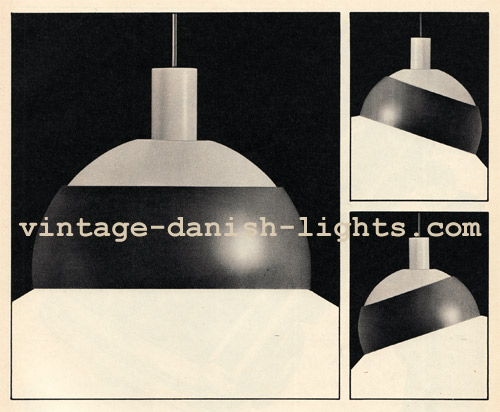
There are, however, exceptions to this rule, which reveal some of the other factors driving vintage value. Finn Juhl’s mid-1960s Lyfa light is a good example. The design, with its tilting shade, was available in wall, table and pendant versions, the latter (pictured above) retailing at the end of 1966 for a mere 134 Danish krone for a 27cm diameter version and 150 kr for a 34cm version. At the same date, retail prices for other Danish lights included 395 kr for the Fog & Mørup Hekla, designed by Jon Olafsson & Petur B Luthersson, 439 kr for Fritz Schlegel’s Lyfa pendant, 236 kr for Verner Panton’s Moon pendant, produced by Louis Poulsen, and 333 kr for Poulsen’s PH table lamp, designed by Poul Henningsen.
Today a collector might expect to pay something in the region of one UK pound for each krone of the original price for all the abovementioned lights – with the exception of the Finn Juhl, for which the asking price is likely to be closer to 10 UK pounds for each original krone.
What lifts today’s price for this light so far above those of its contemporaries? The simple answer is its scarcity. It was not in production for many years and seems not to have sold in very large quantities, so supply today is very limited in comparison with some of the other lights mentioned – some of which are still being manufactured today. Meanwhile, Finn Juhl’s status as one of the great Danish designers and the fact that the Lyfa light is the only light he designed means that demand is high. Thus the intangible forces of demand and supply lift the price of the light onto a plane of its own. Unless, of course, someone discovers a huge cache of unsold stock in an old lighting warehouse.