The paradigm-changing originality of 1960s and 1970s Fog & Mørup light designs and the high cost of their uncompromisingly top-quality production led to countless cheap imitations. Many copyists used the F&M originals as inspiration rather than making direct counterfeits, but Nic at Zeitgeist Interiors has drawn our attention to the existence of some (vintage-produced) very close copies of Jo Hammerborg’s Orient.
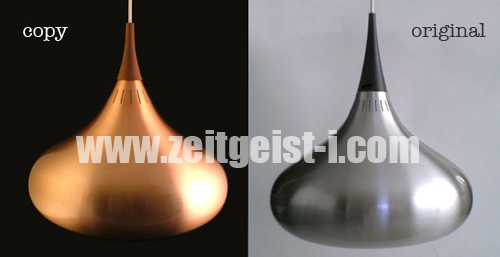
Like Fog & Mørup’s original Orient, the copies were produced in both copper and aluminium versions. Nic sent us the images above and below of a copper copy alongside a genuine F&M aluminium Orient, and says: “You’ll see that the wooden cap is less well-fitted and much smaller on the copy, and that the slots are longer and fewer. It doesn’t show quite as well, but the shape of the copy puts more emphasis on the ‘bulging’ part of the lamp, with the gradient from the top half to the bottom half being more marked in its curvature.”
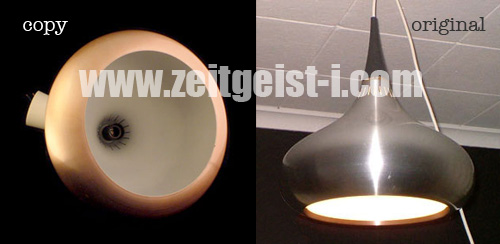
The most obvious difference, however, lies at the opening to the lamp’s body, where the original F&M version has a folded-back lip on the rim edge. The copy has no such fold and simply terminates at the rim. The hole is also a different size, so the plastic diffusers (removed for the photos) are not interchangeable between the original and the copy. Nic also notes that whereas genuine F&M Orients come with a rosewood cap in the copper version and an ebonised wood cap in the aluminium version, he has seen at least one copy aluminium version with a plain, non-ebonised wood cap.
Nic says he has found these close copies only in the UK. Certainly we ourselves have never seen them in Denmark in 10 years of buying there, and our ever-vigilant Danish friends Sune and Claus confirm that they have never seen them in Denmark either.
Could they have been produced outside Denmark by an official subcontractor? In the 1960s and 1970s Fog & Mørup sales to Europe and the United States were by export from Denmark, but some lamps were made under licence at Yamagiwa in Japan for the Far East market. But the many small (but significant) design differences and the considerable difference in quality suggest that they are very unlikely to be part of that licensed Japanese production, and Nic’s conclusion – with which we concur – is that they are almost certainly counterfeit copies.
With many thanks to Nic at Zeigeist Interiors.
Day: 23 June 2010
-

F&M Orient lookalikes from the UK