Every area of vintage/antique design collecting has pitfalls and dangers, and vintage Danish lighting is no exception. Here’s our five-point guide to making sure that your investment is sound and that you’re not throwing your money away.
1. Check that the light really is what the seller claims it is. While a few unscrupulous sellers do deliberately set out to mislead, the overwhelming majority of false attributions come from sellers who simply repeat unsubstantiated information from other sources. Sometimes the mistake is the attribution of an incorrect designer or manufacturer to a genuinely collectable light, in which case its value may not be significantly affected by the mistake. A greater danger to your investment arises when a lookalike copy of a valuable original is offered as the original light it’s been copied from. Fog & Mørup light designs from the 1960s and 70s, for example, were widely copied for a market eager to adopt but unable to afford the company’s innovative but expensive productions, and it’s not unusual today for these poorer-quality lookalikes and imitations to be attributed to F&M, often citing Jo Hammerborg as designer. Both kinds of mistake have a tendency to ripple out across the internet and even appear in sources that might be thought to be reliable, such as auction house listings and design encyclopedias. For reliable information, refer to our own directory of vintage Danish lighting, which is compiled entirely from primary sources such as original manufacturers’ advertisements and product catalogues.
2. Check the light’s condition carefully, and if buying online ask the seller for a condition report if none is provided. The resale value of a vintage light drops significantly with scratches, rust, dents, bends and other damage, but some sellers do not take account of this when setting their own selling price. Beware of terms like patina being used as a euphemism for damage. Patination is a natural outcome of age and normal use in materials like wood and copper, and is not the result of insult, injury or exposure to inhospitable conditions. Also beware of vague phrases like “as you would expect in a lamp this age”. In fact there is no reason why you shouldn’t expect the bodywork of a 1960s or 1970s pendant light to be in near perfect condition if it hasn’t been damaged in transit between one installation and another: there are usually no moving parts to create “wear” (another word to be wary of). Look out too for interventions such as repainting, which will destroy the value of all but the most exceptionally rare vintage lamps and significantly reduce even those.
3. Make sure there are no missing parts. Some lights, for example Verner Panton’s Flowerpot for Louis Poulsen, and Jo Hammerborg’s Saturn and Erik Balslev’s Radius for Fog & Mørup (pictured below), have parts that have to be removed to replace the bulb. It’s not unusual for these to go missing altogether, so check before buying.
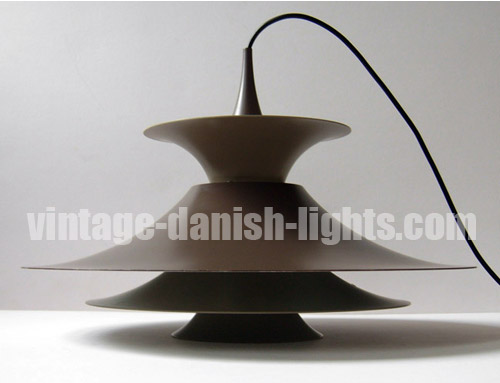
4. If you’re planning to put your vintage light to use at home, make sure it’s safe and legal to do so. The electric components and wiring of many vintage lights are in poor condition, so ask your seller whether the components have been fully dismantled, checked, and where necessary replaced. In the UK, legislation introduced in 2005 requires metal-bodied lighting installed directly into the mains to have three core wiring and bulb-holder, but vintage Danish lighting nearly always comes with a two-core set-up, so ask your seller to convert. Bear in mind, however, that removing original components may have a small impact on the light’s value, especially if it is done using components that don’t match the style of the originals.
5. Finally, check that the light is indeed a vintage original and not a later production or reissue. Many vintage designs are still in production or back in production by a different manufacturer. These will not maintain and increase their value in the same way as an original vintage example.
Day: 7 June 2010
-

Tips for buying vintage Danish lights